Sunday, August 21, 2005

Evening snack

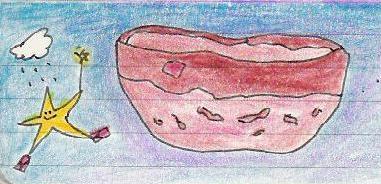
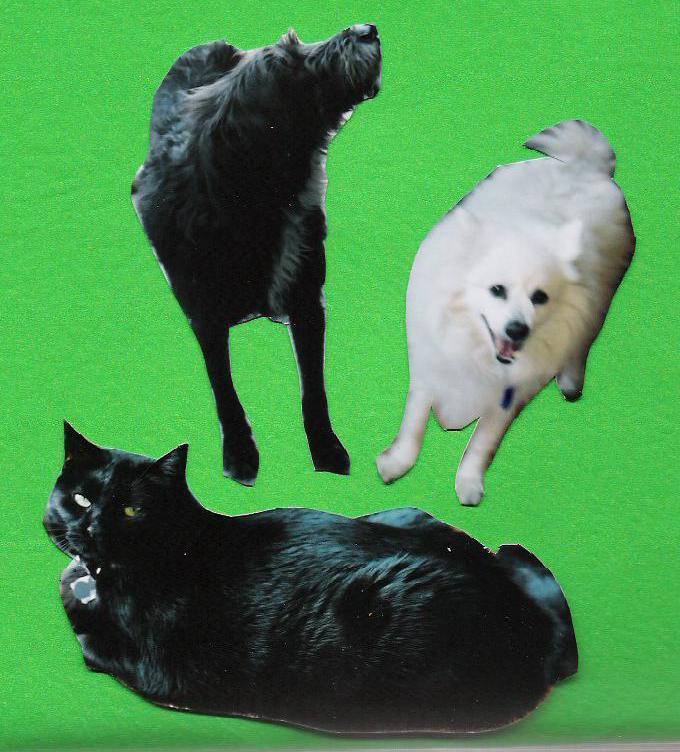
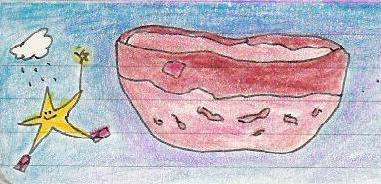
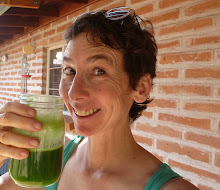
Just in from a walk with Yuki. Before that, I was at Singing Bird Sangha, the Thich Nhat Hanh meditation group I sit with in Tucson. Now, I am eating a yummy, warm sandwich of crunchy salted natural peanut butter with fruit jam on whole wheat sourdough toast and drinking a tall glass of soy milk to which I've added kuro goma kinako 黒ごまきな粉 (black sesame seed powder), a Japanese treat that my friend Chi gave me. It makes the soy milk taste sesame-y and naturally sweet.
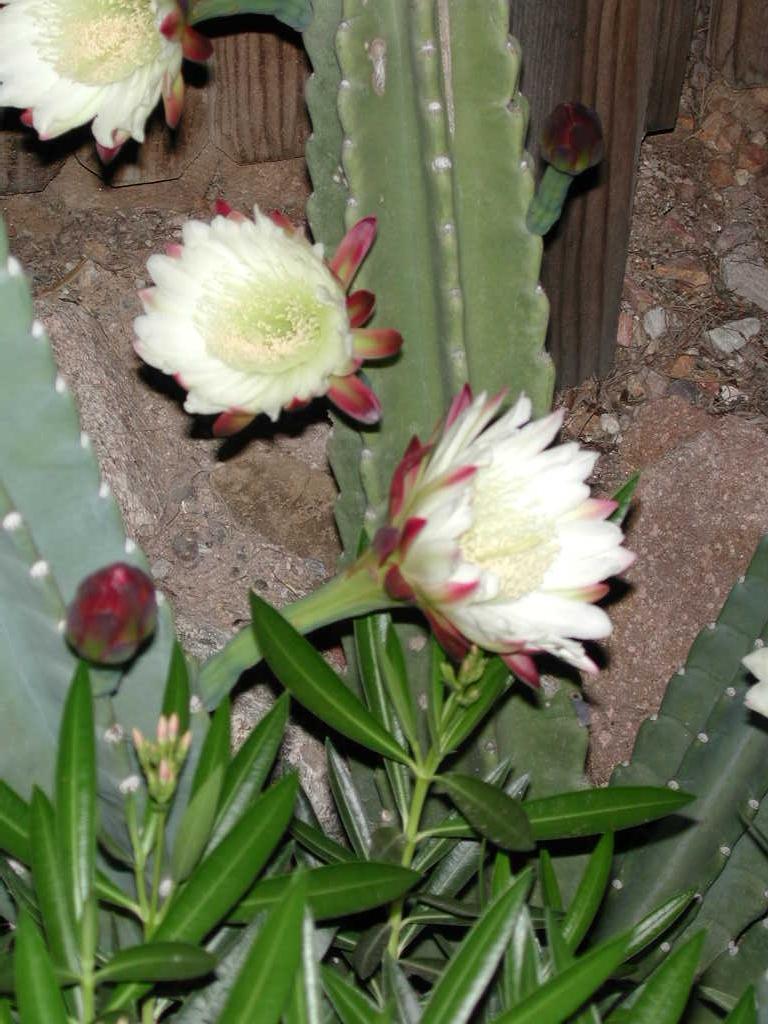
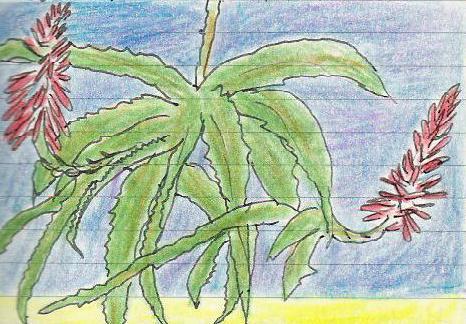
On our walk, I saw that the night blooming cerius had opened with the light of the still bloated full moon. So, I took a picture. Here it is.


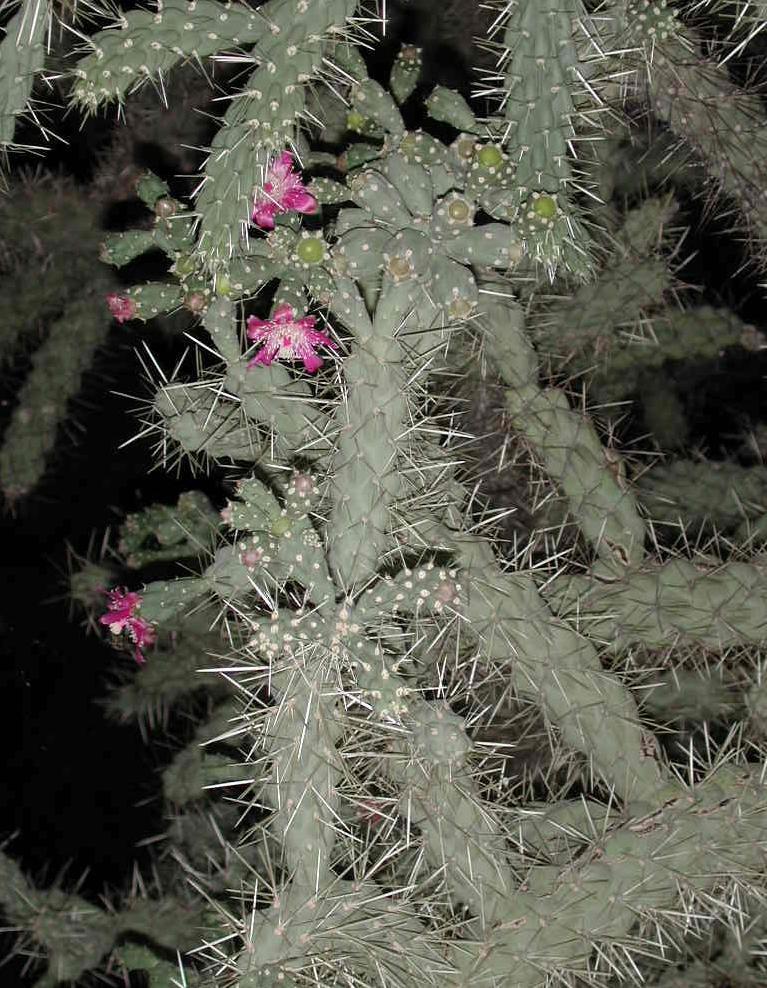
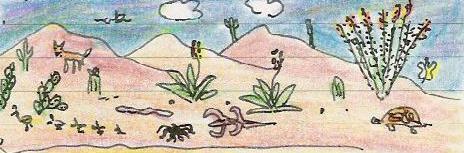
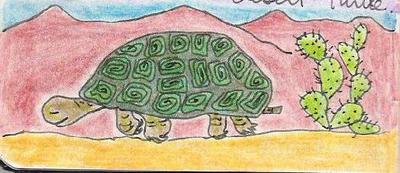
And the following photos I took last night on my way to Himmel Park with Yuki--Prickly pear, cholla, and flowering cholla.


At Himmel, we stumbled upon the mini luau and dance rehearsal of the Tucson Polynesian Club. Yuki got a discarded rib to chomp on and I got to listen to lovely Polynesian music and watch hula dancing. They'll perform in front of Old Main on Wednesday wearing their traditional dress. I plan to go see.

Wednesday, August 17, 2005

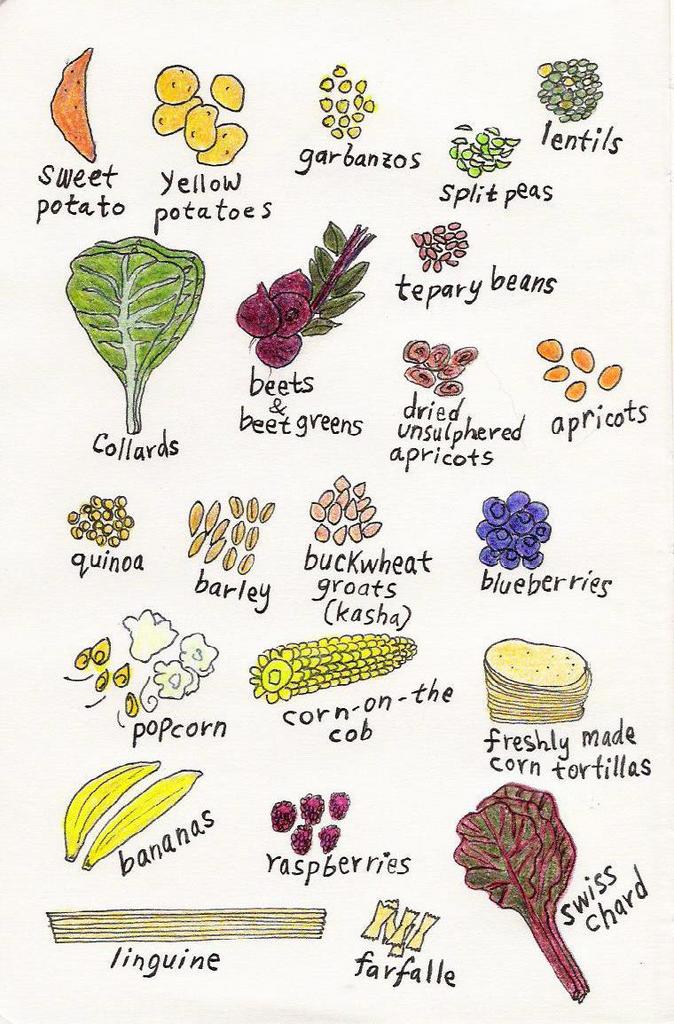
The foods I eat, part II


Here's the next tier of my favorite, or main, staple foods (I have a lot). At first, I thought to lay out all my foods into concentric circles. The inner circle would display the foods I eat most, while each successive circle would contain foods I eat, but not as much as my inner circle foods. In reality, what I eat depends on the seasons, availability, what my body needs, where I am living, and my resources.

Tuesday, August 16, 2005

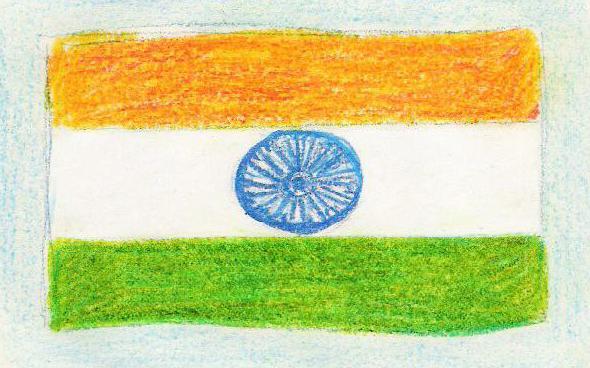
Happy Independence Day, India


In honor of India's Independence Day, August 15th, I am posting an interesting article on Swaraj, the Hindi concept of self-rule, and the Prime Minister's address.

Monday, August 15, 2005

Reading fun


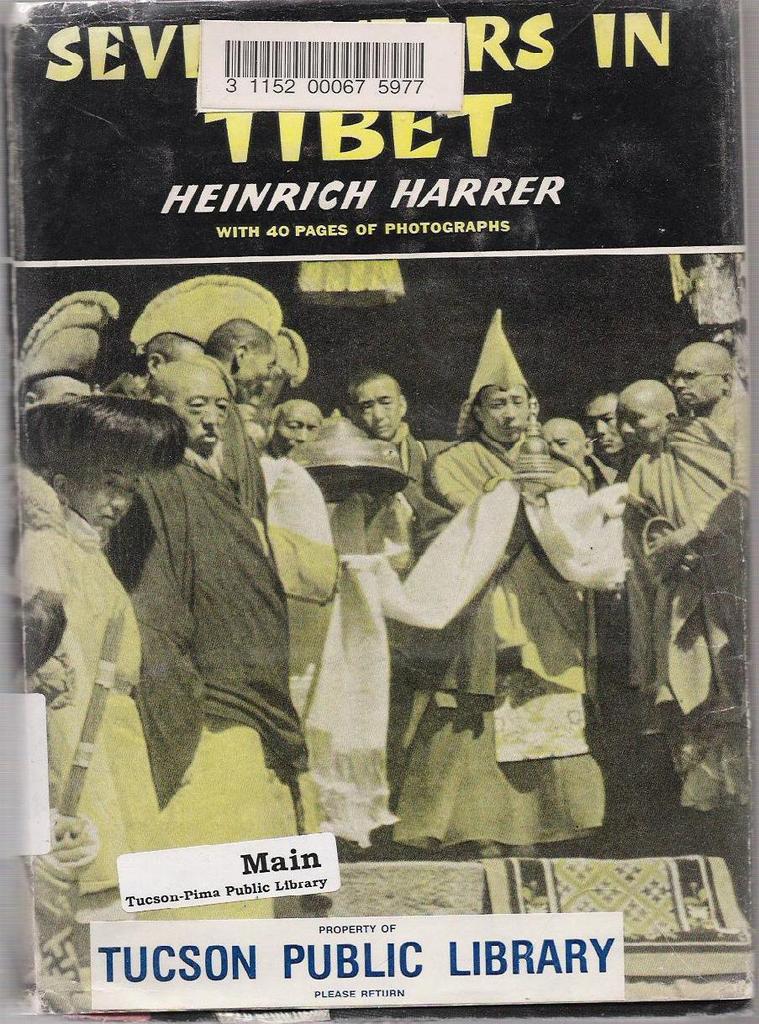
Well, I found two books at the Main Library that I have been wanting to read: Seven Years in Tibet by Heinrich Harrer, translated by Richard Graves, and Beyond the Sky and the Earth: A Journey into Bhutan by Jamie Zeppa. I'm already 90 pages into Seven Years in Tibet, finding it very exciting with much more detail than is portrayed in the movie (though I like the movie version very much).

Another thing I'm enjoying about Seven Years in Tibet is the physical book itself. It's a 1953 first edition copy, hard-bound and printed on thick, soft, ivory colored paper that is so nice to hold. There are black and white photographs and maps to consult as Herr Harrer journeys through Tibet.

The second book, Beyond the Sky and the Earth, is written by a Canadian woman who went to Bhutan (!) in 1988 to teach English (about the time I was returning from my 3-year adventure teaching English/living in Japan). I might give a report after I read it. For now, Herr Harrer's tale awaits.

Tashi Delek!

Saturday, August 13, 2005

Enso 今日の心

"Calligraphy is a picture of the mind."
~Chinese saying


"Enso is the circle of infinity, symbol of simplicity with profundity, emptiness with fullness, the visible and invisible. It sometimes forms a moon, sometimes a rice cake.
Usually the circle is begun near the bottom of the left-hand side and the ink is thickest there. Although the shape is the simplest imaginable, each circle is different. Some are almost perfectly round and others are quite lopsided. The shading of the ink also greatly influences the effect of the character. In your practice it is good to write one enso each session."
~John Stevens, Sacred Calligraphy of the East, p. 190.

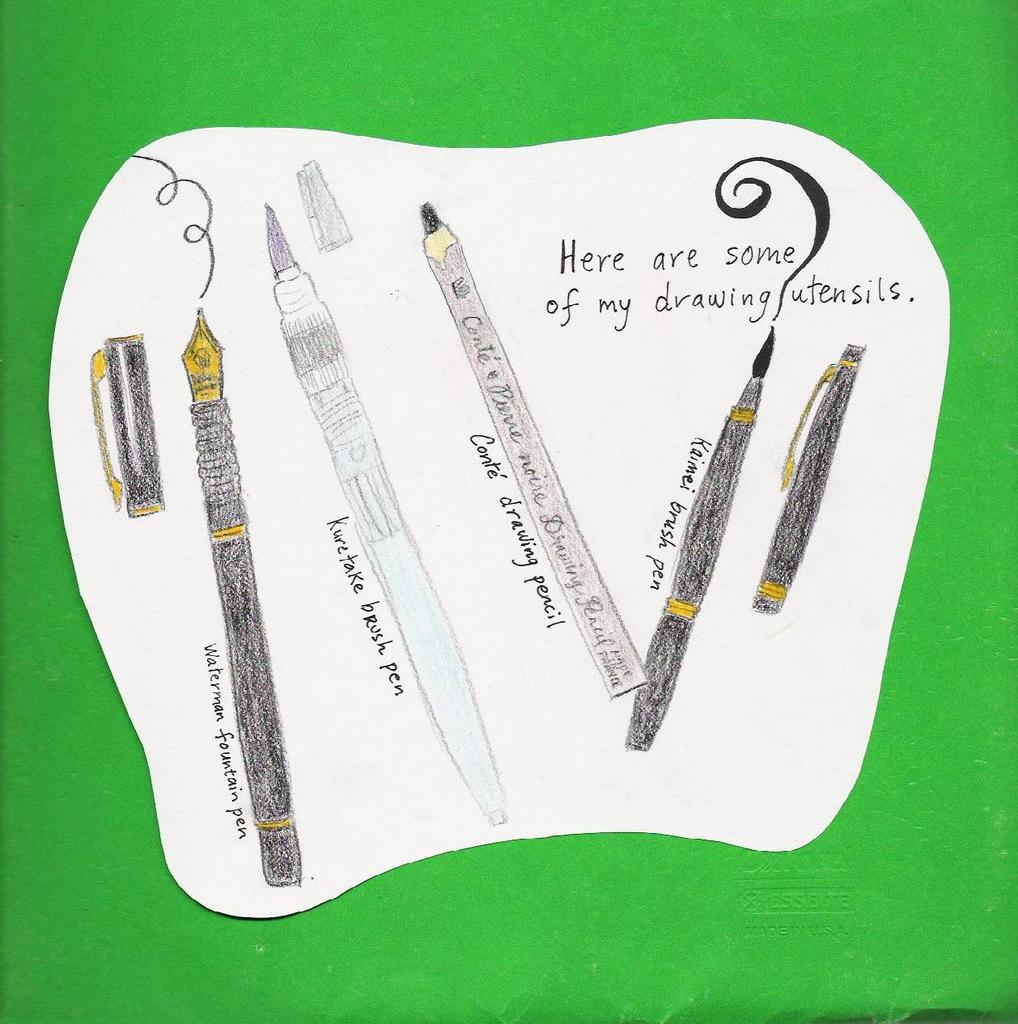
Here are some of my fude 筆 (brushes):

Wednesday, August 10, 2005

The foods I eat

This is a drawing of my main "staple" foods.


I like to draw things from daily life. I got to thinking about the foods I eat because of two headlines I saw last week, one about the Atkins diet company bankruptcy and the other about the serious food shortage in Nigeria. Many people in the US pay money to lose weight while millions of people in Africa are starving to death. It doesn't make sense. We have access to so much food variety in North America while millions of people in poorer countries are starving. Millions of Nigerian mothers would be happy to have enough of just one type of food (i.e., millet or casava) to feed their malnourished children. I appreciate that many of the Asian food items I enjoy come to me from across the ocean, via ship, train, and truck. And, I wish there was something tangible I could do to help feed people who are starving.

Tuesday, August 09, 2005

Peace Message from Nagasaki's Mayor Itoh


Today the bells of Nagasaki echo in the sky, marking 60 years since the atomic bombing. At 11:02 a.m. on August 9, 1945, a single atomic bomb was dropped from an American warplane, exploding in this same sky above us, instantly destroying the city of Nagasaki. Some 74,000 people were killed, and another 75,000 wounded. Some of the victims never knew what happened. Others pleaded for water as death overtook them.

Children, so burned and blackened that they could not even cry out, lay with their eyes closed. Those people who narrowly survived were afflicted with deep physical and mental wounds that could never be healed. They continue to suffer from the after-effects of the bomb, living in fear of death.

To the leaders of the nuclear weapons states: Nuclear weapons must never be used for any reason whatsoever. This we know from painful experience. For sixty years we have repeated our plea, “No more Hiroshima! No more Nagasaki!”

International society has also been exerting effort for the prohibition of nuclear weapons tests and the establishment of nuclear-weapon-free zones. In 2000, the nuclear weapons states themselves promised an “unequivocal undertaking” for the “elimination of their nuclear arsenals.”

Nevertheless, at the end of the Review Conference of the Parties to the Treaty on the Non-Proliferation of Nuclear Weapons held at United Nations headquarters in May of this year, no progress was achieved. The nuclear weapons states, and the United States of America in particular, have ignored their international commitments, and have made no change in their unyielding stance on nuclear deterrence. We strongly resent the trampling of the hopes of the world’s people.

To the citizens of the United States of America: We understand your anger and anxiety over the memories of the horror of the 9/11 terrorist attacks. Yet, is your security actually enhanced by your government’s policies of maintaining 10,000 nuclear weapons, of carrying out repeated sub-critical nuclear tests, and of pursuing the development of new “mini” nuclear weapons? We are confident that the vast majority of you desire in your hearts the elimination of nuclear arms. May you join hands with the people of the world who share that same desire, and work together for a peaceful planet free from nuclear weapons.

To the government of Japan: Our nation deeply regrets the last war, and our government has supposedly resolved not to engage in actions that might lead to the tragedy of war again. The peaceful ideals of our constitution must be upheld, and the threefold non-nuclear principle of neither possessing, manufacturing, nor allowing nuclear arms within our borders must be enacted into law without delay. The efforts of concerned countries for nuclear disarmament on the Korean peninsula, combined with the concomitant results of the threefold non-nuclear principle, will pave the way for a Northeast Asia nuclear-weapon-free zone. We urge you to adopt a stance that does not rely upon the “nuclear umbrella,” and to take a leading role in nuclear abolition.

We would also point out that the atomic bomb survivors have become quite elderly. We further call upon the Japanese government to provide greater assistance to those who continue to suffer from the mental anguish caused by the bombing, and to extend sufficient aid to survivors who now reside overseas.

Here in Nagasaki, many young people are learning about the atomic bombing and about peace, and are engaged in activities that they themselves have originated. To our young people: Remember always the miserable deaths of the atomic bomb victims. We ask each of you to earnestly study history and to consider the importance of peace and the sanctity of life. The citizens of Nagasaki stand behind your efforts. May you join hands with the world’s citizens and NGOs, that the bells of peace will ring loud and clear in the sky over Nagasaki.

Today, as we mark 60 years since the atomic bombing, we pray for the repose of the souls of those who died, even as we declare our commitment, together with Hiroshima, never to abandon our efforts for the elimination of nuclear weapons and the establishment of lasting world peace.

August 9, 2005
Iccho Itoh, Mayor of Nagasaki

Sunday, August 07, 2005

Peace Declaration from the Mayor of Hiroshima


PEACE DECLARATION
 
 This August 6, the 60th anniversary of the atomic bombing, is a moment of shared lamentation in which more than 300 thousand souls of A-bomb victims and those who remain behind transcend the boundary between life and death to remember that day. It is also a time of inheritance, of awakening, and of commitment, in which we inherit the commitment of the hibakusha to the abolition of nuclear weapons and realization of genuine world peace, awaken to our individual responsibilities, and recommit ourselves to take action. This new commitment, building on the desires of all war victims and the millions around the world who are sharing this moment, is creating a harmony that is enveloping our planet.
 
 The keynote of this harmony is the hibakusha warning, "No one else should ever suffer as we did," along with the cornerstone of all religions and bodies of law, "Thou shalt not kill." Our sacred obligation to future generations is to establish this axiom, especially its corollary, "Thou shalt not kill children," as the highest priority for the human race across all nations and religions. The International Court of Justice advisory opinion issued nine years ago was a vital step toward fulfilling this obligation, and the Japanese Constitution, which embodies this axiom forever as the sovereign will of a nation, should be a guiding light for the world in the 21st century.
 
 Unfortunately, the Review Conference of the Nuclear Non-Proliferation Treaty this past May left no doubt that the U.S., Russia, U.K., France, China, India, Pakistan, North Korea and a few other nations wishing to become nuclear-weapon states are ignoring the majority voices of the people and governments of the world, thereby jeopardizing human survival.
 
 Based on the dogma "Might is right," these countries have formed  their own "nuclear club," the admission requirement being possession  of nuclear weapons. Through the media, they have long repeated the incantation,  "Nuclear weapons protect you." With no means of rebuttal, many  people worldwide have succumbed to the feeling that "There is nothing  we can do." Within the United Nations, nuclear club members use their  veto power to override the global majority and pursue their selfish objectives.
 
 To break out of this situation, Mayors for Peace, with more than 1,080  member cities, is currently holding its sixth General Conference in Hiroshima,  where we are revising the Emergency Campaign to Ban Nuclear Weapons launched  two years ago. The primary objective is to produce an action plan that  will further expand the circle of cooperation formed by the U.S. Conference  of Mayors, the European Parliament, International Physicians for the Prevention  of Nuclear War and other international NGOs, organizations and individuals  worldwide, and will encourage all world citizens to awaken to their own responsibilities with a sense of urgency, "as if the entire world  rests on their shoulders alone," and work with new commitment to abolish  nuclear weapons.
 
 To these ends and to ensure that the will of the majority is reflected at the UN, we propose that the First Committee of the UN General Assembly, which will meet in October, establish a special committee to deliberate and plan for the achievement and maintenance of a nuclear-weapon-free world. Such a committee is needed because the Conference on Disarmament in Geneva and the NPT Review Conference in New York have failed due to a "consensus rule" that gives a veto to every country.
 
 We expect that the General Assembly will then act on the recommendations  from this special committee, adopting by the year 2010 specific steps leading  toward the elimination of nuclear weapons by 2020.
 
 Meanwhile, we hereby declare the 369 days from today until August 9, 2006,  a "Year of Inheritance, Awakening and Commitment." During this  Year, the Mayors for Peace, working with nations, NGOs and the vast majority  of the world's people, will launch a great diversity of campaigns for nuclear  weapons abolition in numerous cities throughout the world.
 
 We expect the Japanese government to respect the voice of the world's cities and work energetically in the First Committee and the General Assembly to ensure that the abolition of nuclear weapons is achieved by the will of the majority. Furthermore, we request that the Japanese government provide the warm, humanitarian support appropriate to the needs of all the aging hibakusha, including those living abroad and those exposed in areas affected by the black rain.
 
 On this, the sixtieth anniversary of the atomic bombing, we seek to comfort  the souls of all its victims by declaring that we humbly reaffirm our responsibility  never to "repeat the evil."
 
 "Please rest peacefully; for we will not repeat the evil."
 
 August 6, 2005
 
Tadatoshi Akiba
 Mayor
 The City of Hiroshima

Friday, August 05, 2005

Remembering Hiroshima: August 6th, 1945


Sixty years ago, at 8:15 in the morning on August 6th, the B-29 Enola Gay dropped a nuclear bomb called "Little Boy" over the center of Hiroshima. An estimated 80,000 Japanese women, men, and children died instantly. Another 60,000 died due to radiation poisoning by the end of 1945. Many thousands more people have died since then from radiation-related causes. When the bomb hit, ordinary people were going about their lives, drinking tea, walking to school, reading the morning paper, taking a street car to work.

The A-bomb was a small beginning. Currently, many of us believe there is little threat of nuclear war so we do not actively oppose nuclear devices. We hear reports that 'developing' countries are building up nuclear weapons, while ignoring the fact that we have steadily increased our nuclear weapons stockpile. One of our modern nuclear missiles is many hundreds of times more powerful than "Little Boy". I heard Dr. Helen Caldicott speak on nuclear arms and disarmament at MIIS last year. The quantity of nuclear warheads in existence and the gruesome details of death by radiation she gave were frightening. We have to disarm.

Sometimes when I walk out to my car, I think what it would be like to be an Iraqi, Palestinian, or Israeli going into my car, or just walking by someone else's parked car, and getting blasted to death. Or, just enjoying some tea and getting vaporized instantly by heat that sucks your skin off and melts you--it could happen. Unless we disarm. We have to talk about it, become informed, educate others, and continue working towards total disarmament.

For more information, click on Dr. Helen Caldicott and interview and
nuclear policy

How do we disarm? His Holiness the Dalai Lama says that peace begins in the individual:

Although attempting to bring about world peace through the internal transformation of individuals is difficult, it is the only way. ... Peace must first be developed within an individual. And I believe that love, compassion, and altruism are the fundamental basis for peace. Once these qualities are developed within an individual, he or she is able to create an atmosphere of peace and harmony that can be expanded and extended from the individual to his family, his community, and eventually to the whole world.

Tuesday, August 02, 2005

ゆき

This is a charcoal drawing I made of Yuki.


A couple of days ago, a friend from Pacific Grove composed this haiku for Yuki:

Yuki dreams of snow
Ahhhhhhhhhhh so cool and refreshing
Snow dreams of Yuki


Right now, in the dark, coolness of a cloudy night (76ºF), Yuki and I will go out for a walk. He doesn't know it yet--it's a surprise.

*FYI: Yuki means 'snow' in Japanese. It can be written in hiragana [ ゆき ], katakana [ ユキ ], or kanji [ 雪 ]. Yuki-chan prefers the hiragana.

Who draws


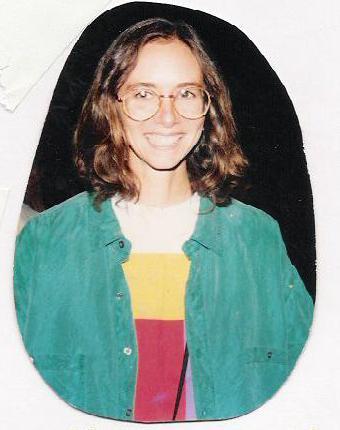
I thought I'd liven up the page a little with this smiling photo of me from 1994.
I was 33. Now I'm 44.
I'll have to dig out a photo of me when I was 22 and 11, since this blog is my shrine to me and I like those kind of numbers.
My hair has gotten longer--then shorter--and my glasses have gotten smaller, but otherwise, I look pretty much the same.
A friend took this photo of me at the 20th (?) anniversary street celebration of Antigone Books in Tucson, Arizona, on 4th Av. Barbara Kingsolver and Leslie Marmon Silko were among the special guest speaker/readers that night.

Yet the question remains: Who is doing the drawing?
Raise your hand if you know the answer.

Saturday, July 30, 2005

Puppets


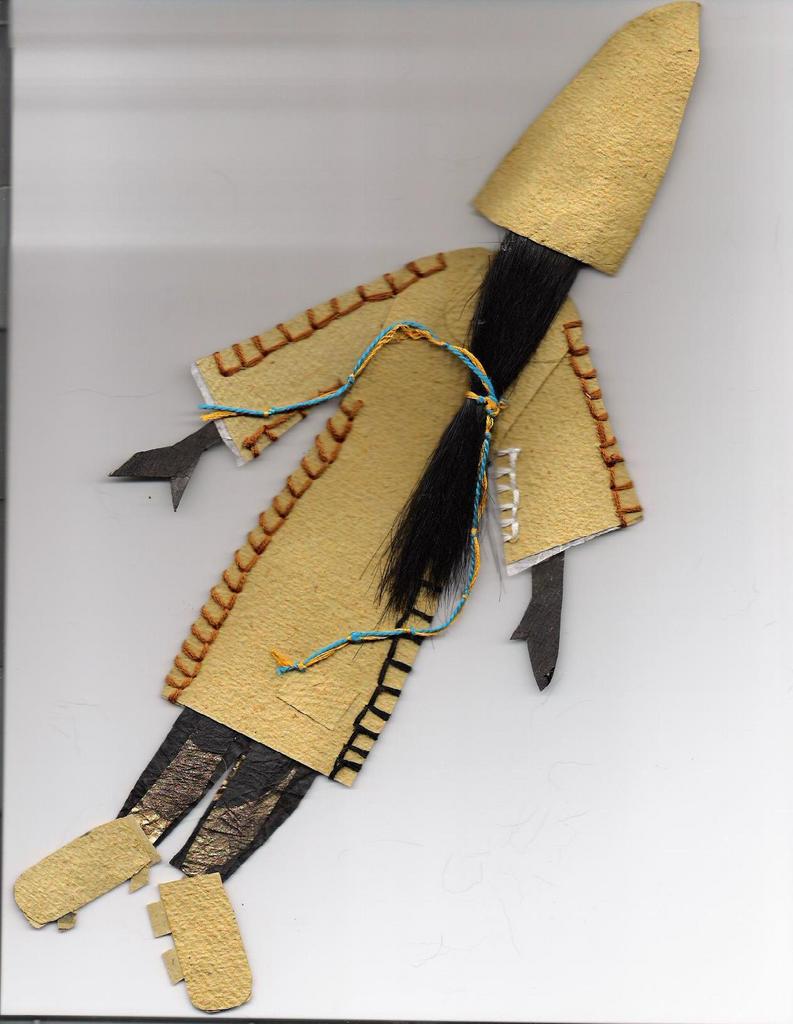
Tonight I went to Poetry & Potluck Night at Zen Desert Sangha (ZDS). All who come are invited to share poetry, read from a favorite book/author, sing, show & tell something, or play an instrument, etc. I decided to make and bring a puppet show. My idea for the puppet show comes from the story of the Emperor Who Wore No Clothes. I haven't written the script yet. I made one puppet who has two different looks depending on the hat s/he wears. In the first conical hat, the puppet looks like she is a cross between a Shinto priestess and a Heian period aristocrat.

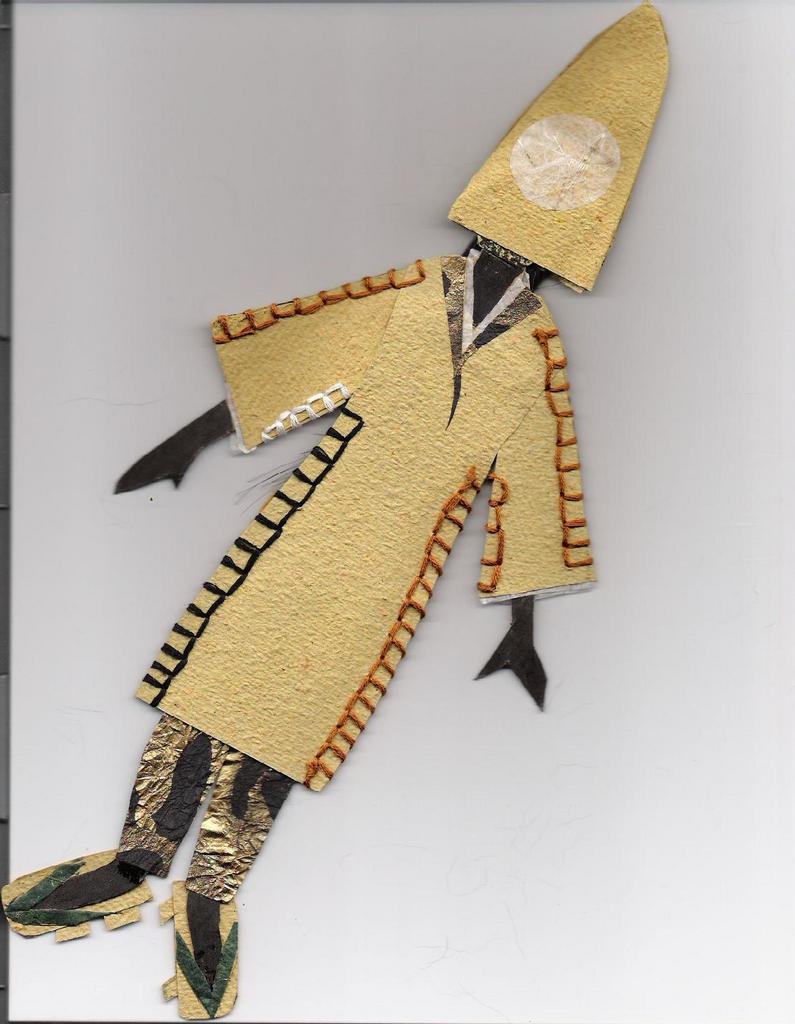
When the little pill box hat is put on, the puppet becomes a man from Africa who, someone at ZDS said, "is from the United Nations". He also has an optional outer robe (below). Just goes to show you, we are people of many hats.


Other treats tonight: David played his bass, a huge cello-like instrument, but much larger than a cello. We all examined his beautiful bow made of horse hair, with inlaid mother-of-pearl and silver on the shiny orange toned wood. Diane and her husband displayed the earthtone quilt they have been sewing and Debbie read us her poetry. I also played my Native American cedar flute and Joe played some Kalimba (aka, 'thumb drum'). I've always liked show & tell. My favorite subjects in school were show & tell, lunch, art, P.E., and recess. Yay for recess!

Thursday, July 28, 2005

Life as sand mandala

I woke up from a dream in which I was a sand mandala. The sand painting was finished; the grains of sand were being swept back into the earth, carried on the wind. I woke up taking a conscious breath in and out, then a big breath in and out. I looked at the sky: a beautiful blue with just a few small cloud puffs over the Catalinas.

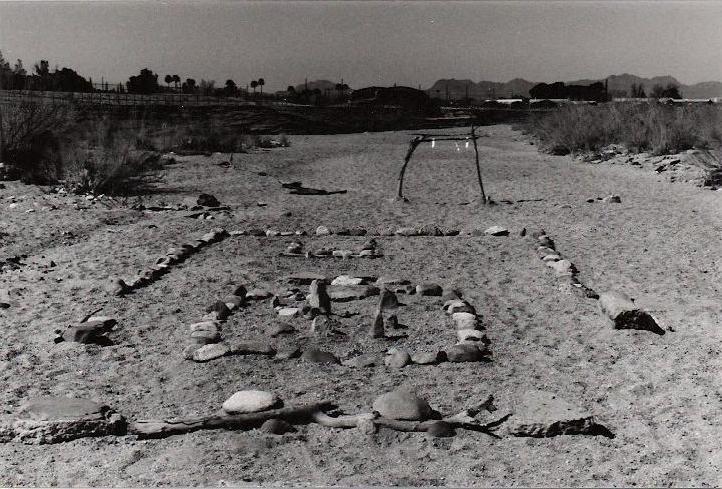
I thought yesterday about an art happening that evolved a few years ago down in the rillito. One day in February, I began to move stones and boulders to create a rock garden on the expanse of dry river sand. I scavenged pieces of drift wood and twigs and iron rebar to make Japanese gates called torii (等り). Yuki hung out down there with me as I played.


Everyday, I spent my mornings moving rocks and creating new formations in the garden before going to teach pottery. Each day, I brought pieces of my hand made pottery to the garden, little offerings. In the evening, Yuki and I would again walk to the rillito. People from the neighborhood began to congregrate there, sunset walkers mostly, many with their dogs. Everyday, I found surprises in the garden: rounded spiral rock paths had been carefully placed, shiny stones were laid out in a pattern, glassy beads and small tin bells appeared hanging from one of the torii gates, a miniature shrine had been created beside a large boulder. Some items seemed to have disappeared only to appear in another spot, and some items found new, temporary homes with an admirer/visitor to the garden. The garden was no longer "mine".


There were no rules, yet everything that was placed was a natural found object from within the rillito; no one used plastic (with the exception of my pottery pieces, the seven-inch kami--paper--streamers I sewed around the torii, and some jute). People continued to visit, making the rillito rock garden a destination to walk to and a place to play and create with their whole bodies. It was never crowded, though, and always felt peaceful and playful. My idea was to work/play down there until the monsoons came and washed it all away. What happened was a little different.

One day at the end of May, I walked down there to find the rillito rock garden had been torn apart, vandalized. At first, I felt disappointed that I was not going to see everything float away and would not see moist, grainy river sand the next day where the garden had been. And, I imagined the energy of the ones who broke everything. Then, I let go of thinking. I could not control a perfect 'flowing' outcome. The end came differently then expected. Actually, so did the middle. I set out to move stones, to move my body, and to play at something that delights me (building things). I never expected that a community would come to meet it and that it would playfully engage many individuals.

Tuesday, July 26, 2005

The Real Work


The Real Work

It may be that when we no longer know what to do
we have come to our real work,
and that when we no longer know which way to go
we have come to our real journey.
The mind that is not baffled is not employed.
The impeded stream is the one that sings.

~Wendell Berry (Collected Poems)

* * * * * * *

I'm going to put a new category on my CV called The Real Work.
Duties: being baffled and singing.

Sunday, July 24, 2005

昼ご飯 hirugohan


These are the dishes from my lunch today (昼ご飯 = lunch). I ate rice with furikake (ふりかけ = sprinkles of sea salt, seaweed, and sesame seed) and some strips of kim (Korean seaweed), chilled silken tofu with oshoyu (おしょう油 = soy sauce), a bowl of steamed kale drizzled with olive oil and apple cider vinegar, and Li li xiang oolong tea from Seven Cups Tea House here in Tucson. It was a delicious lunch.
おいしい (oishii).

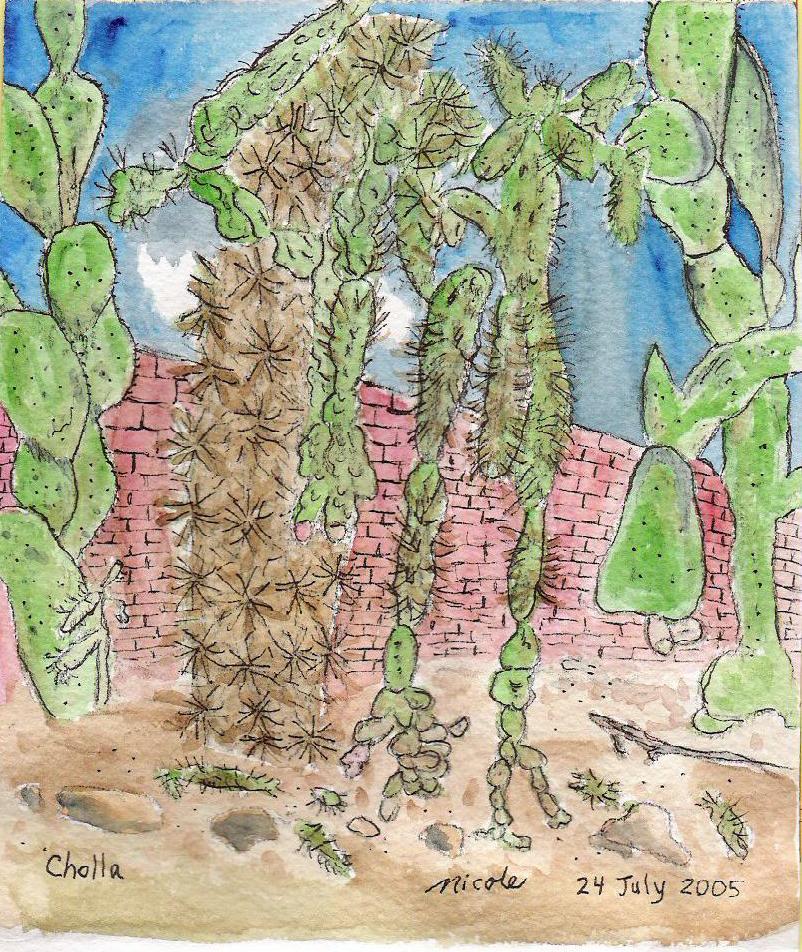
After lunch I went on a walk with Yuki to a stand of plump cholla along the rillito. Plump and healthy from all the Spring rains and just waiting to be sketched. I saw a few little pink flowers on the cholla, but I didn't paint them. I also saw bees moving inside the flowers. We were able to walk in the middle of the day because it is cloudy today--woohoo! Relief from the summer sun.


On our way back, I saw a big bird flying from the tamarisk brush down in the rillito to a perch in a tall pine tree on the path above.

At home I consulted my trusty little bird book and found an illustration that looked like it, so I think it was a turkey vulture.

I'm having fun putting Japanese into my writing now that I figured out how to use that feature on my iBook.
楽しい -- tanoshii -- fun!

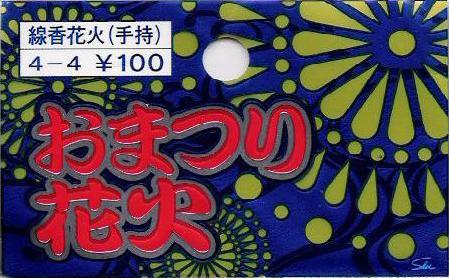
By the way, the Japanese graphic on my July 13th Pea soup entry has nothing to do with pea soup. I just wanted to see how printed plastic packaging would look scanned. The package is お祭り花火 (omatsuri hanabi) which means 'festival fireworks'. These 花火 (hanabi) were sparklers that I lit in the backyard on Fourth of July. Swirling them around was also very 楽しい。The word hanabi is 楽しい, too. It is composed of 'hana' 花 which means flower and 'bi' 火 which means 'fire'. So, 'fireworks' in Japanese is 'flower fire' 花火.

Tuesday, July 19, 2005

One with the heat


"A monk asked Tozan, 'Cold and heat descend upon us. How can we avoid them?'"
"Why don't you go where there is no cold or heat?"
"Where is the place where there is no cold or heat?" the monk asked Tozan.
He replied, "When cold, let it be so cold that it kills you; when hot, let it be so hot that it kills you."

* * * * * *

"When in a hot place, become one with the heat. When in a cold place, be one with the coldness. Don't resist, whatever it is. When cold, shiver. When hot, sweat."

~Extracts from Subtle Sound: The Zen Teachings of Maurine Stuart, pp. 41, 42.

Sunday, July 17, 2005

Sand storm

Yuki and I had a little adventure tonight while out walking in the neighborhood. We got caught in a gusty, windy, dust storm! I had planned our walk so as to arrive back home when the torrential rains would be released. I was imagining laughing as the rain soaked our bodies and the fresh smell of creosote filled our lungs.
All afternoon I watched the huge white and gray monsoon clouds form in the sky. At first, the warm wind blew strongly, and we walked slowly, so I could practice my walking meditation (Yuki was doing his sniffing meditation). Then the wind picked up.
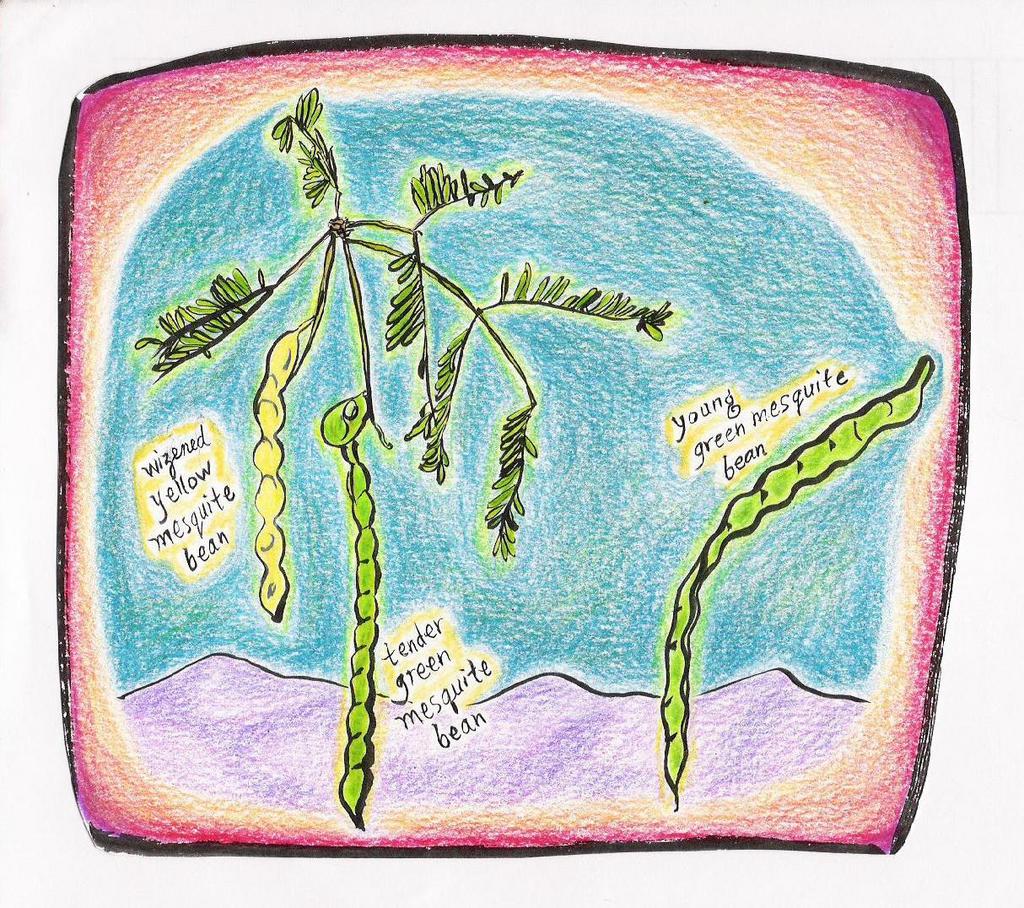
It whooshed through the dry eucalyptus leaves, tearing bark off the trunks. Clusters of pale yellow mesquite pods shook loose to the ground. The sky was darkening behind us, so I decided it was time to head back. But what I thought was a blanket of rain rolling towards us turned out to be a sand storm.
The air was so dusty and gritty that we had to crouch behind a wall for awhile to let it all blow by. Yuki was getting hit face on from the higher blowing gusts, as well as from the grit and dust being churned up from the ground. At least I have the protection of eyeglasses and could use my free hand to shield my face; Yuki just has his delicate white eyelashes. No wonder camels have long eyelashes.
Here's my new motto: "crouch behind a wall and let the grit go by".

Distressing thoughts

Last night I woke up in the middle of the night tossing and turning with troubling thoughts of Laura Bush. A few days earlier I’d read an AP article from Dar Es Salaam, Tanzania, with the headline, Mrs. Bush Seeks to Empower African Women. My first thought was, "Really....Laura Bush?" How is a privileged white woman, who is neither Muslim nor African, going to empower “African women”? And, what a big assumption it is to imply that all African women are the same!

The First Lady was traveling in Africa with her twin daughters, giving speeches and visiting hospitals, schools, and orphanages in Rwanda, Tanzania, Capo Verde, Zanzibar, and South Africa. The article said that she would visit a Muslim school in Zanzibar that had received one thousand US dollars in seed money from the President’s $15 billion in aid package (Oh, look, world, the US will even support Muslims).

In her speeches, Mrs. Bush stressed the importance of equality for women in such things as voting rights, involvement in politics/government, and improved literacy for girls and women. All good things, I agree. Yet, troublesome coming from a woman whose life experience bears little resemblance to that of “the African woman.” Laura Bush has a ‘here’s-what-you-need-to-fix-it’ approach (the strong helping the weak, broken one) rather than a service approach that sees the other as equal and identifies with the other’s suffering and joy. Even so, I am glad that the G8 meetings produced billions of dollars in pledged aid and debt forgiveness for Africa.

In another article I read of Mrs. Bush’s visit to a Rwandan cemetery to 'pay tribute' to the hundreds of thousands of Tutsis and Hutus who were killed (eight hundred thousand, I think). Though the report said she hardly showed emotion, she said she was “moved.” She later asked Rwandan President, Paul Kagame, what we could do to prevent other genocides from happening. Good question and an ironic one. She also never publicly mentioned Darfur. Cherie Blair, wife of British PM Tony Blair, accompanied Laura Bush to Rwanda. She was quoted as saying, "I am very moved by what I have seen, also distressed that the world looked on while it happened.” It seems that we are all looking on while people are being killed and raped in Darfur. It could turn into another Rwanda.

Wednesday, July 13, 2005

Pea soup


I just finished a late dinner of thick split pea soup and some 梅入りこんぶ茶(ume iri konbucha), a delicious hot drink made of kombu seaweed and salty-sour Japanese plum.
I left the university area tonight after sunset. On my way through the university on the bike path, I heard the unmistakable sound of Native American chanting along with deep rhythmic drumming. I rode to the source, a group of Native American chanters, seated on the grass between the new student union/bookstore and the Mountain Avenue parking lot. There were seven men seated on chairs in a circle around a big drum all drumming and chanting in unison. Standing on the grass near the circle, four Native American women blended their higher voices with those of the men and the drum. I stopped a while listening with my whole body, smiling.

The chanting was so familiar and welcoming. Already, I had had a wonderful afternoon and felt so happy and contented, yet there was even more joy. Even more.

Today, all day, I enjoyed the rare summer treat of clouds covering the sun. In the late afternoon, big cool raindrops landed on my skin for the minute or so that it lasted. Later on, I saw orange-y pink clouds at sunset. I also studied and wrote (translation: I worked on my portfolio). And, on my late afternoon jaunt at epic café, I had a fun conversation about education, bilingual education, and things Asian with a retired UA librarian, followed by a spontaneous visit to the clay studio of one of my former pottery teacher colleagues--where I again met the librarian. After that, I happened upon the chanting and was…well… enchanted . No wonder chanting is part of healing way ceremonies; it makes us whole.

Tuesday, July 12, 2005

Evening cool


It was 112ºF today (44.4ºC).

Yuki & Jesse sprawl out on the ceramic tile floor to stay cool. Yesterday, on not quite four hours of sleep, I bicycled the 5 miles to the university when it was 105ºF. Today, I stayed in all day until the time desert animals should be going out--at dusk.

It's amazing how cool it feels--even at 100ºF--after the sun goes down. It's now 98ºF, and delightful, at a quarter to eleven in the evening. Jesse is outside romping about, still alive; she hasn't gotten eaten by a coyote yet. Tonight, after making myself study at epic café for a few hours with an icy lemonade, I ate outside on 4th av. I ate two yummy tacos at Martín's (comida chingona) with cool cups of horchata, savoring both the after sunset darkness and the flavors.
I shared a mosaic tile table on the sidewalk with a young surfer-looking dude. Turns out he's from Southern California originally, did his doctorate at Berkeley, and is currently a UA optometrist conducting research on astigmatism amongst the young O'odham population. He told me the O'odham have one of the highest rates of astigmatism in the world, probably genetic.
In other news, I read that Lance was wearing the maillot jaune after day one of the alpine climbs.

Saturday, July 09, 2005

Me, sketching

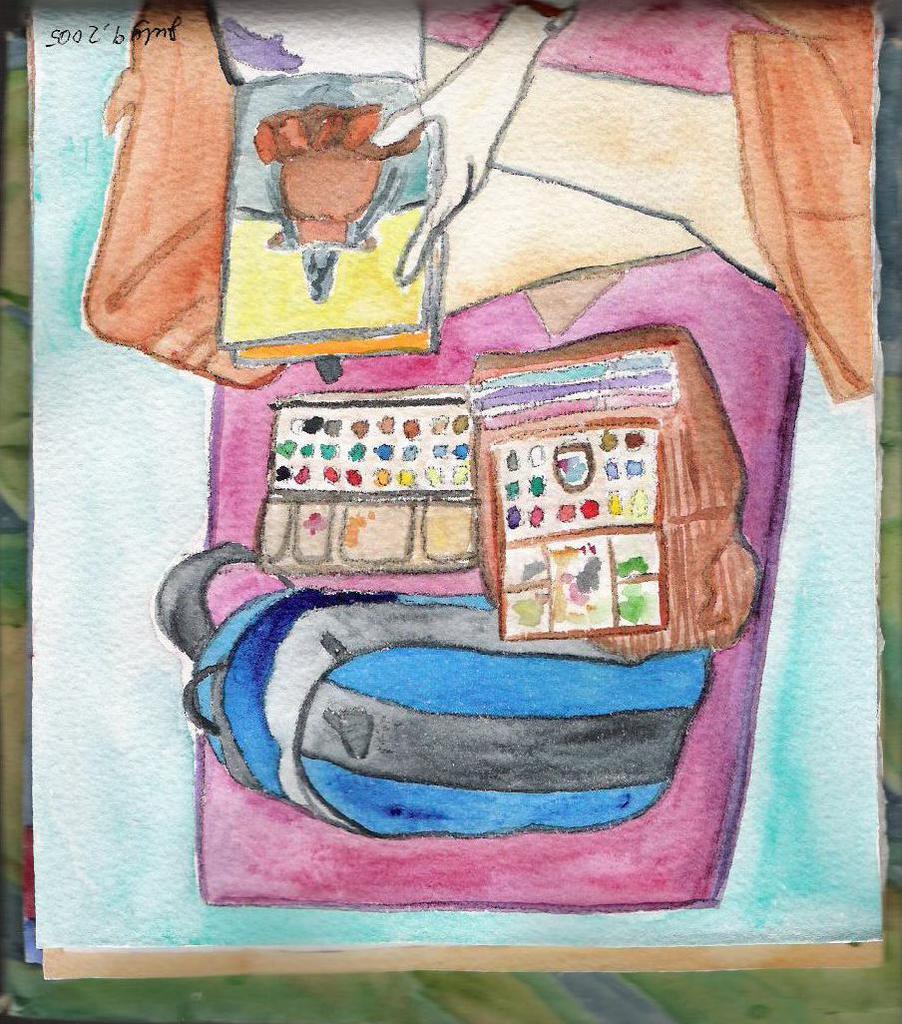
Here's a watercolor sketch I did today. I was sitting on a low wall outside in the shade under tall palm trees next to the university area Starbucks. The Starbucks is in a 1940s adobe. I sat between pigeon droppings as I sketched, feeling the sweetness of the hot decaf grande caramel macchiato that I'd recently finished. I decided to scan in this drawing as if one of the pigeons was looking down on me sketching.

Wednesday, July 06, 2005

HapPy Birthday, Jetsun Jamphel Ngawang Lobsang Yeshe Tenzin Gyatso - Holy Lord, Gentle Glory, Compassionate, Defender of the Faith, Ocean of Wisdom


In honor of the 70th birthday of His Holiness the Dalai Lama,
here are some lines from Shantideva:

The Bodhisattva Path

May I be the doctor and the medicine,
And may I be the nurse
For all sick beings in the world
Until everyone is healed.

May a rain of food and drink descend
To clear away the pain of thirst and hunger,
And during the eon of famine
May I myself change into food and drink.

May I become an inexhaustible treasure
For those who are poor and destitute.
May I turn into all things they could need,
And may these be placed close beside them.

Without any sense of loss or attachment,
I shall give up my body and enjoyments
As well as all my virtues of the three times
For the sake of benefiting all.

By giving up all, sorrow is transcended,
And my mind will realize the sorrowless state.
It is best that I now give everything to all beings
In the same way as I shall at death.

May I be a protector for those without one,
A guide for all travelers on the way.
May I be a bridge, a boat, a ship
For all who wish to cross the water.

May I be an island for those who seek refuge
And a lamp for those desiring light.
May I be a bed for all who wish to rest
And a slave for all who want a slave.

May I be a wishing jewel, a magic vase,
Powerful mantras and great medicine.
May I become a wish-fulfilling tree
And a cow of plenty for the world.

Just like space
And the great elements such as earth,
May I always support life
Of all the boundless creatures.

And until they pass away from pain,
May I always be the source of life
For all the realms of varied beings
That reach unto the ends of space.

Friday, July 01, 2005

My month in review


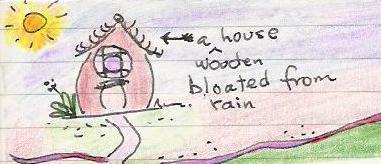
It’s been about a month now since I left the watery ocean world of Monterey and came back to the dry and mountainous Tucson desert. I remember my first wet winter in Monterey (2003-4) when it rained so much I thought the wooden houses might swell up and float away.
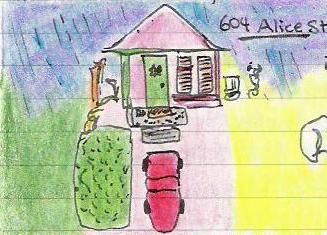


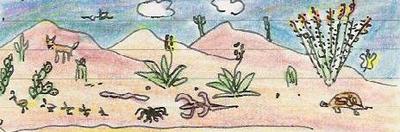
Today, with not a cloud in sight, the sun burned all day, reaching a high of 111ºF. Currently it is a cool 100ºF. I stayed inside all day today until sunset time, just like smart desert animals do. But unlike unencumbered lizards, snakes, coyotes, and white-tailed rabbits at dusk, I wielded two leashed and excited dogs tonight as I walked with Sadie and Yuki on the grass at Himmel Park. In the relative coolness of nightfall, people were out in the park playing Frisbee, playing soccer, doing tai’chi, walking with their dogs, and playing tennis.


* * * * * * * * * * * * * * * * *

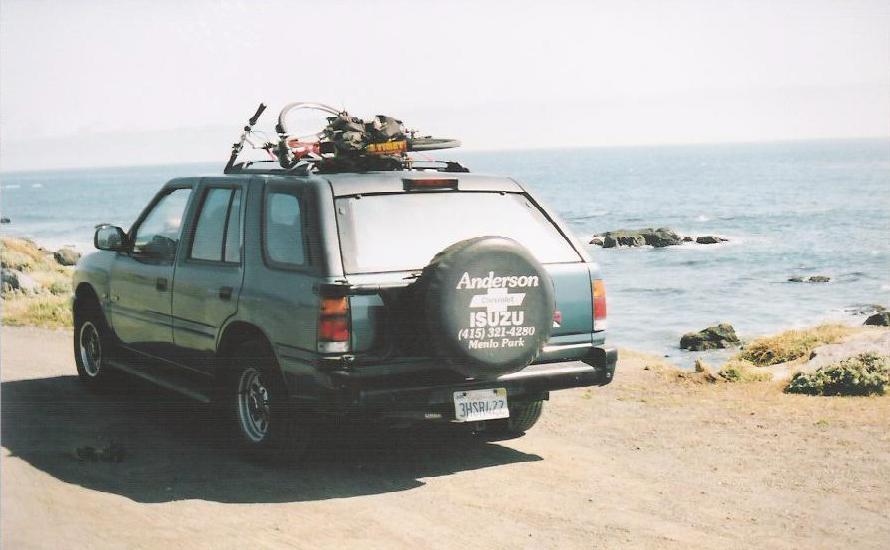
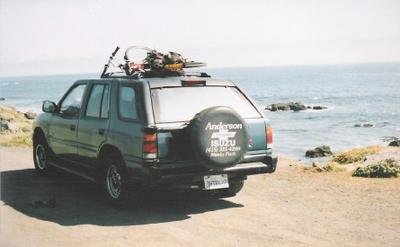
I love the simplicity of road trips. On our way back to Tucson, I had my new vehicle packed with all my stuff. I made it comfortable for Jesse and Yuki. As a cat, Jesse had the run of the place. Yuki had only the passenger seat to curl up in, as I, too, had only the driver’s seat. So, we made frequent stops to stretch and move as we made our way down the coast. I decided to take scenic Hwy 1 for most of the way down to San Diego. Yuki and I walked around at almost every vista point along the highway.


The elephant seals were especially fun to watch—and smelly—hundreds of them were laying close together, inching on top of each other as they basked in the sun on the beach. I also enjoyed looking at sea birds and other sea creatures through my binoculars. I saw what looked like two breaching whales, but I’m not sure. They may have been two elephant seals, in which case, they appeared to be dancing.



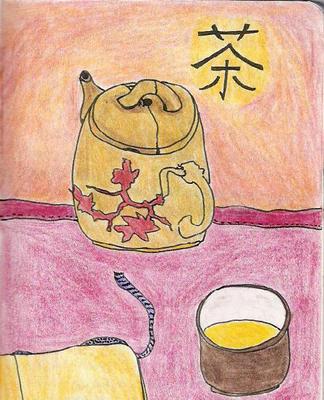
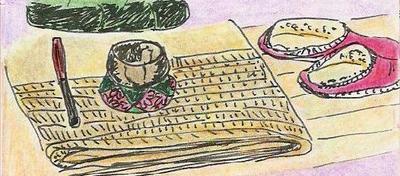
I brought my camping gear, including my little Whisperlite cook stove, planning to cook meals like I did on my way up to Monterey in July of 2003. This time, it felt simpler to eat the raw foods I'd packed: Asian pears, carrots, snap peas, and several pb&j sandwiches. For tea, I requested hot water for my thermos at McDonald’s. I enjoyed drinking the tea from one of my little ceramic teapots when I stopped.


Our first night (5/26) we slept under oak trees in my tent at El Capitan campground near Santa Barbara. Yes, Jesse likes to sleep in my tent. So does Yuki. I bring Jesse’s litter box in there and Yuki’s water bowl, which they both use, and we are quite cozy in my 2-person dome.


In the morning, I put Yuki and Jesse inside the Isuzu while I was washing up, but discovered when I was ready to take off that all the doors were locked with my keys inside. I saw the keys dangling from the ignition. You’d think after twelve years together that Yuki would be able to read my mind and have the dexterity to just hand me those keys dangling so close to his head. But, no, he was just looking at me. Luckily, I had rolled down the window about 2-3 inches for Yuki & Jesse. Unluckily, unlike my former little Geo Metro, the Isuzu windows are power windows and could not be budged simply by pushing on them. I tried to fit my arm in the crack, but could only make it as far as my wrist. So, I asked the white-haired man camping in the space near mine whether he had any wire or even a wire coat hanger to try to lift up the inside lock. He said he’d look. In the meantime, I walked down the other way and came upon a VW bus family. After I described how big the crack in the window was, they lent me their little boy. They thought he might be able to get his arm through if I lifted him up. Even his little arm was not small enough to reach through. He told me he was in second grade and that they were camping but didn’t live there. He seemed very independent, and he had long hair past his shoulders. Soon, the white-haired man returned with some light gauge wire, which he had fashioned into a fishing hook. He tried to get the lock up, but wasn’t hitting it. I tried and got it right up. Yay! We were on our way.
If the wire hadn’t worked, I would have called AAA; I have a membership.


The next day was another fun day of driving. I listened to dharma talks the whole way down: Pema Chodron’s “Awakening Compassion”, Thich Nhat Hanh’s “Ultimate Dimension: Teachings on the Avatamsaka Sutra”, and Eckhart Tolle, The Power of Now, and stopped at ocean overlooks whenever I could. It was Friday of Memorial Day weekend and as I approached the Los Angeles area the traffic got noticeably heavier. I decided to drive through LA instead of stopping to see my cousin. In Encinitas, I took a rest from driving to enjoy one of my favorite gardens. The garden is built on a cliff overlooking the ocean on the grounds of the Self- Realization Fellowship. There are many varieties of flowering Asian plants, alcoves and benches for contemplating the garden, a small cactus garden, and lushly vegetated koi ponds with big gold, red, orange, and white speckled koi. I took Yuki for a walk in the adjoining Guru Park, named for SRF founder, Paramahansa Yogananda (Autobiography of a Yogi). In the park, while Yuki enjoyed sniffing everything, I did a shortened version of all the exercises I had been doing with my Monterey Senior Center exercise buddies. Moving my body like that from head to toe is a great way to stretch out after long hours of sedentary driving.


We drove ‘til late that night, about 70miles from Gila Bend, and stopped at a dark pullout where some other cars and trucks had parked for a rest. I parked under a tamarisk tree in a sandy area and made a comfortable bed on top of all my stuff inside the Isuzu. I slept until dawn.


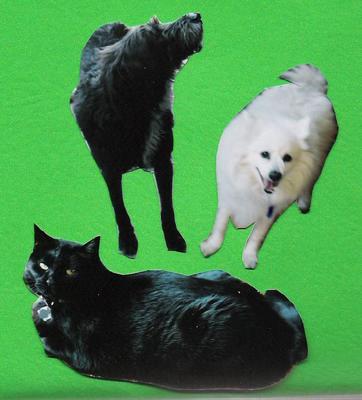
We arrived at Darci’s in the afternoon on Saturday. Yuki and Jesse met Sadie, Darci’s 2-year old wolfhound, golden retriever mix. The three of them sniffed each other, watched each other, and moved about the house together without any trouble right from the beginning. It was amazing.
In the early evening it actually monsooned. An auspicious beginning to my stay in Tucson.


There is no time, really. We live, doing things and moving through space. Months pass, moments pass. If I reflect on what I do during a specific period of time, I see that I do a lot. While I am being and doing, I don’t think that I am doing a lot at all, so it is always surprising to me to uncover all that action. I once wrote a prose poem entitled, “If I was tagged like a bear” after realizing how much I do--how much we all do--in a single day. I'd need a radio transmitter attached to my body to actually remember everything, every move, every glint of sunlight that moves me, every person I smiled at or talked with, etc. It’s too much, really. It’s the same with this month in review. There’s too much for me to tell. So I will end here, now. And elements or episodes of this month will merge into next month, into another entry, another conversation, another story, ‘cuz that’s how things flow: through space and time; always in transition. But one thing’s for sure: there is only this moment, now. Life is only available in the present moment.